Showing posts with label practice. Show all posts

Saturday, June 13, 2015

One day, one bloom


I've been contemplating this cactus flower for more than a week now. I'm not 100% what kind of cactus it belongs to, though I saw it up close, a large, narrow, spiny variety, sitting on the porch of our Joshua Tree vacation rental last week. The flower was a bud when we arrived, and over three days we saw it ripen, and by the morning of the New Moon, it had burst into flower (I found out that moths and bats pollinate night blooming cactus as insects and birds take care of the day bloomers). I took a picture of course — it was too beautiful — and I would quickly learn, acutely impermanent: Cactus flowers only last one day.
Be evening it had closed up onto itself, spent. 
 All that focus and energy for one glorious performance. HmmmMmmm.

Monday, May 4, 2015

10 Ways to Get Unstuck & Finish What You Started


Making stuff — songs,  stories, magazines...pies — has been my through line for most of my life. Creating is for me one of the coolest things about being alive. How amazing it is that humans can make things out of 'nothing?' How much one can find out about themselves through doing.  Now I chart my fluidity, or my stuckness, by how my projects are proceeding. Usually there's a match up to what I'm feeling.  I'm likely stuck if I'm feeling frustrated, cranky, oppressed somehow or over-tired (in a way that sees sleep as a way out rather than as a restorative). I'm usually stuck if I'm feeling fear of some kind,  or that my circumstance is compromised. Over the years I've been fortunate to find several practices that have worked for keeping me, or getting me, back on track when I'm stalling out. As I've been working on getting my arms around a big project that has eluded me for some years — years in which I've actually completed lots of projects (albeit other projects) — I've been turning to my favorite ways — that don't involve plane tickets or other large purchases — to get unstuck a lot!

10 Ways to Get Unstuck & Finish What You Started

  1. Do some yoga. Even five minutes of breath and movement can change your perspective. If you've never done yoga, try a beginner class or commit to learning sun salutations. I have a regular yoga practice so this has become built in. Now, if I'm resistant to my yoga practice,  I do what I consider my 'minimum RDA:' 20 minutes of my regular practice, including sun salutations, a few standing and some seated poses.
  2. Vocalize. Another built-in for me as I regularly chant and I sing.  When I was going through a low period, I found these were things that made me feel better. Sound vibration and music affect us physically, psychologically, emotionally and spiritually. Make a sound=shift in consciousness.
  3. Go for a walk outside, preferably up a hill. For most of my life (until recently), I've lived near some geographic feature I could ascend. Going for a walk + changing the view +breathing the air = gear change. But you don't need a hill. A walk around the block can do wonders. My new15 minute loop near my house gets my blood moving and... doesn't take me too far from what I'm working on.
  4. Make/bake something easy. Often my stuckness is a result of being daunted by a project. Making something edible reminds me I can complete a project and also make something useful. When I was young, I liked to bake. Now I've been more into raw, vegan snack type things, that don't take all day and are truly nourishing.
  5. Set a timer. Sometimes thinking/worrying about the thing I'm resisting — making that call, writing the next paragraph, paying the bills,  learning the new song that hasn't been getting in— than actually doing it. Setting a timer for a amount of time that's not overwhelming — 10 minutes to half hour — helps gets me started, which is key, and usually leads to completion.
  6. Dance. Blast a favorite tune and go to town...even if town is in your living room. Dance is play and counters the over-seriousness business.
  7. Mix up your usual routine so your usual sequencing is different.  Perhaps it won't offer up any resistance when approached at a new angle.
  8. Take part in a challenge. I'm a big proponent of 'write a [novel, album] in-a-month' type challenges or Instagram # sharing challenges. They're manageable, they're contained and it helps to know you're not alone.
  9. Reach out. Connect to another maker, or someone who is doing what you aspire to, or simply an old friend. Up the ante by writing a real old-fashion letter.  Write as a fan or to say thank you. Or write your friend to tell them the things you love about your life right now. Make it equal parts gratitude list and reconnection. Put your letter in an envelope with a real stamp. Walk it to the real mailbox.
  10. Take time from social media. See what the vacuum left by Twitter and Facebook yields. 
  11. Make a list. 10 projects you admire.  5 next steps to take. 15 things you've already completed. All the things you do well. Wow, look at that!

Friday, May 1, 2015

Read.Eat.Listen: All


Anyone who has practiced traditional Ashtanga yoga has heard "practice and all is coming." It was one of Ashtanga-originator Pattabhi Jois's favorite instructions: a succint way of saying: do your practice first, everything else, the 'all' of life, positive and negative, as well as the fruits of practice, will work themselves out. It's at once an inspiring, maddening and accurate instruction. Inspiring, because when things are hard, who doesn't want to hear that it will change or become clear? Maddening, as this direction is nowhere near a quick fix. And accurate, because, as someone who began Ashtanga during a low, low point in ones life, I've experienced the steady expansion that goes hand-in-hand with regular practice. Even when I've felt pissed, injured, bored, old, lazy, or disappointed with my practice, I know now, over years of coming back to the mat, all (all kinds of all) does come.
This week, quite serendipitously, we had opportunity to stay a few days at Rancho Valencia, a spa resort in San Diego County replete with tennis courts, swimming pools, fine restaurants, olive and citrus orchards, beehives, and multiple swimming pools. Tastefully decorated with original art, our suite was larger than our house and just as comfortable (if not more so!). The only thing missing was our cat...who will likely never forgive us. Hummingbirds buzzed the patio morning and evening, and freshly squeezed orange juice was delivered to our door each morning. A lot of allness
Though our every need was taken care of, and there was even a yoga pavilion, I ventured outside the grounds a couple of mornings, to practice at the Ashtanga Yoga Center on the border of Encinitas and Carlsbad. I've made many trips to Encinitas over the years, as it's the first place in the United States that Pattabhi Jois taught when he first came to the States in the 70s, and several teachers have since maintained Ashtanga's strong roots here. I practiced with Jois here in 2002, on one of his many teaching trips, and several times with Sharath Rangaswamy after he took over the reigns from Jois upon his passing.  Likewise, one of Jois's first American students, Tim Miller, has run hid influential Ashtanga Yoga Center here for many years. I was fortunate to practice at his studio this week, my first visit to the Carlsbad location. While the studio is now inland a bit, in one of San Diego County's seemingly omnipresent malls, Miller's big heart and dedication permeates the Center, a practice environment that strikes an admirable balance between friendly, relaxed and focused. 
Read: Oliver Sacks' "On the Move." If you've read any of his other books or articles — "Awakenings" or "The Man Who Mistook His Wife for A Hat"—you know Sacks is brilliant and human, warm and wise, light-hearted and endlessly curious. I'm so glad he sought to pen and complete his memoir "On the Move" which is a beautiful look inside the life and mind of one of our greats.
Eat: "Food is the final frontier [of practice]," wrote another senior Ashtanga teacher, David Garrigues, and this entry, alas, doesn't speak to a fully-tamed frontier (albeit all the food in question is organic). I first tasted hushpuppies as a 10-year-old on my first trip through the deep, southern US. Fried and with a name I thought was funny, the Louisiana-made cornmeal hushpuppies weren't anything like I'd tasted before. I can still remember the wonder I felt at their flavor. But I was only visiting the south and its cuisine. I've seldom come across hushpuppies since (and they're definitely not a dish that fits with my attempts at healthy yoga-practice encouraging eating). Regardless, when I saw "wild ramp and garlic hushpuppies" on the menu at Full of Life Flatbread, the foodie and wine-wise restaurant in Los Alamos where we pit-stopped on our way to San Diego, I had to place an order. They were presented beautifully in a white bowl with yummy green goddess dressing. I was a little underwhelmed by their flavors, but my childhood memory is a hard one to live up to. I'm not complaining. These circa 2015, California versions evoked a strong and happy memory...and went great with the house red, a salad and some of Full of Life's truffle-oil infused cauliflower soup. Yum. 
Listen: Truth be told, we've mainly been listening to ourselves this week, rehearsing our Desert Songs between the yoga and work that brought us here. Nonetheless, we perked up when The Carolina Chocolate Drops came on the radio amid our drive. Modern roots music with a side of gospel, this group is talented, spirited and aware...and no secret. They're at SF Jazz Center in May. 

Tuesday, March 3, 2015

Florida Postcard

I was delighted and privileged to have the opportunity to attend a conference the Florida Nature and Culture Center outside of Fort Lauderdale last weekend. The FNCC is situated on the border of the Everglades Wildlife Management Area so in between conference sessions on Buddhism, philosophy and everyday life, I took out my binoculars and checked out some of the local flora and fauna (ibis and black vultures and anhingas, oh my). Beauty and truth, always a winning combo....


Thursday, October 2, 2014

Catastrophes, Catharsis and a Bit of Ancient Juju

Evan Blaser Photo https://www.flickr.com/photos/evanblaser/
It was a bad night. It wasn't bad in that we weren't unprepared. Not bad in that we weren't presenting the songs as I'd intended. Not bad in that I was just starting out and didn't have a clue. But bad in that it was woefully under-attended: empty seats outnumbered filled seats. I'm past this, I thought. Fortunately good hearts and open ears filled those few seats and music prevailed.
I knew I wasn't the only performer to have faced down such an evening.  I've been at countless other shows where I was the open-eared, good-hearted and unintentionally very select audience member enough to know it's a not uncommon scene.  Sometimes these shows haven't been promoted well; sometimes it's just an off night: The stars didn't align; the big game on the TV was more compelling, or countless other reasons that distract people away from the possibility of getting out to see live music played by dedicated artists.
I've had more than a few conversations of late, with other musicians — accomplished, very realized artists — who were puzzling how to get more people out to their live shows with few clear answers. Nonetheless, performers perform; players play; artists make art; and true practitioners of anything practice, despite the conditions or demand.
Which is why I was immensely appreciative to happen upon HowellDevine deep into the second set of their monthly stint at a local restaurant after my less-than-hoped-for show. First of all, it was the blues, and I had them. Second of all HowellDevine play Mississippi Hill Country, Country and Delta Blues very, very well. Third of all, they play no matter if the joint is heaving with jiggle and jive of 100s of bodies unable to resist their rhythms and beats—which is often the case —or the clatter of waitresses clearing the dishes and serving up last call.
It was late when we arrived. The peak musical experience of the evening was an hour or more past. A few other patrons were talking at napkin-strewn tables and the bartender was grumpy.  One pair of music fans shimmied slowly between the almost cleared tables. But like a trio of marathon runners who gets a second wind at mile 20, Joshua Howell wailed on his harmonica and slid his slide over the fret board that much faster; Pete Devine's arms and legs were moving in all directions, hitting every section of his kit with well-timed precision, while Joe Kyle Jr. more than ably kept time on his bass.
We ordered a piece of apple strudel to share and sat back in our seats to take in their last few songs of the night. Suddenly the night was sublime.
HowellDevine's new CD, aptly named Modern Sounds of Ancient Juju, is hot off the presses. Get it. Go to a show. Keep the music alive.

Tuesday, May 6, 2014

Mom on yoga

Not my mother's yoga book but nonetheless Hittleman's 
books were influential to many!
It dawns on me as Mother's Day approaches that I owe a lot of my appreciation of, and dedication to regular yoga practice to my Mom. She was a stalwart believer in basic physical fitness and had a daily routine with little yoga in it, albeit she didn't call it yoga (she didn't call it 'working out' either).  Most of what she did was Jack LaLanne-inspired exercise routine performed daily sometime between making four kids breakfast, school bus stops and lunch. This was the day of three channels on the TV and a similar number of radio stations. There wasn't any video not to mention the Internet. Looking back, you'd think we were on a different planet, pre-Google, when you learned either at the source, via word-of-mouth, at school, from books or what little TV programming there was. Along with LaLanne, mom followed instructions in a small paperback exercise book featuring photos of a woman in a white unitard and white tights. Again, it wasn't a yoga book, but there were pictures of the woman in in shoulder stand and halasana with accompanying directions.
Between LaLanne on TV and the paperback, my mom followed suit in the living room, albeit in loose jeans and a cotton shirt.
I didn't really get it. I was a kid. Once in a while I'd try something she was doing, but I considered LaLanne a little too strange in his jumpsuits and big cheer, and the woman in the unitard in the book a little too uncool to follow at that time. So like most things about parents, my appreciation for my mom's discipline comes late in life.
I've heard that a propensity for yoga is attributable to interest, or practice, in one's previous lifetimes, so it intrigues me that my mom, despite her European descent and pious Catholicism, quite naturally gravitated toward exercise and yoga. It grieved me she didn't develop a yoga practice when she had opportunity later in her life, but I'm nonetheless grateful for the role model she provided for taking time each day for a practice of self care.


Wednesday, June 26, 2013

Read.Eat.Listen: On the gig

Playing National Music Day Popup Parklets for a Cause, photo by Local Music Vibe


Read: Honestly, it seems like I've been reading Google Maps more than anything lately,  getting to the various gigs this month, not to mention planning out our upcoming trip to and through the Southwest, Colorado and Wyoming. But between the scrolling, I've reread a book that meant a lot to me when I read it nearly 20 years ago "Long Quiet Highway" by Natalie Goldberg, about the practice of writing, the practice of Zen, and generally waking up. Goldberg, of course, is famous for helping other write, and so her prose is especially accessible. Rereading books is like touching base with old friends, and I can see now how this book planted a seed in me of searching for meaning and of learning to be an artist and finding and maintaining a practice.
Eat: Likewise, food prep has likewise gone out the window of late (not sure where we'd be without Harmless Harvest coconut water, Raw Revolution Bars and kale chips. Guess what's going in the cooler?) Furthermore, when you're gigging a lot, you generally eat at the gig or near it. I jokingly say that playing Off the Grid, the round-up of gourmet food trucks, is the best smelling gig I have. I recently had some exceptionally good eats before playing a recent OtG, a We Sushi 'burrito' which swapped out the flour tortilla for seaweed to create something light and yummy, kind of a high-end hand-roll.
Listen:Mavis! Has a lovely new collection "One True Vine", produced by Jeff Tweedy, no less. Here's "I Like the Things About Me"

Thursday, January 10, 2013

Portland: Go west, near east

It's no secret that one of the many great things about Mysore-Style Ashtanga Yoga is the global tribe of Ashtanga practitioners. Visit nearly any place in the world and you can likely scare up at least a couple Ashtangis with whom to share practice. I've found practice groups everywhere from living rooms in Santa Cruz found by word-of-mouth to the most bustling urban capitals. Portland is no different, with at least two established Mysore groups. When I visit Portland, I call up a local I met in India in 2008 to set me in the right direction. This go Karen graciously shepherded me to Near East Yoga, a Northeast Portland studio led by Casey Palmer, which has been going strong for a good number of years. On-point instruction, good vibe, friendly community...what else does an Ashtangi need?
Well... food. We found post practice eats at Bijou Cafe which knows how to make a kick-ass, authentically French omelet. Plus they'll serve with a salad.  Très bon. (Yogis know better than to enter the Voodoo Donuts outpost up the street from Bijou, but I can't tell you how many Portland residents told me about Voodo so I'd be remiss not to mention it. Voodoo is renowned both for wacky flavor combinations as well as anatomically correct donuts. The actual Voodo donut features a pretzel stick stake through it's doughy heart.) Back to Bijou, the cafe not only serves great food but hosts a weekly Supper Jazz series on Friday's. Next time...Visiting on the front end of a week, we missed a whole slew of Portland's musical scene (other than the visiting guitar in the hotel room). Fortunately, Jimmy Mak's Jazz Club, in the Pearl District, hosts an interesting program of resident and touring artists nearly every night of the week. We enjoyed an early show by a young Portland ensemble on Tuesday in its cozy dinner club listening room. Yes, life is good in Portland.


Monday, September 26, 2011

Perfect Circle: REM, Alex Grey & The Mission of Art


 Three days after the 1989 earthquake, a college classmate and I drove a long roundabout route from UC Santa Cruz to the Concord Pavilion to see REM play live. Santa Cruz and the rest of the San Francisco Bay area was reeling from the damage caused by the 6.9 earthquake and the usual roads were closed to traffic so a usual 2-hour or less drive took more than 3 hours. Sill, while we were at once traumatized and in shock from coming through the epicenter of earthquake unscathed, we were Ã¼ber excited to see the concert. REM provided much of the soundtrack to my college years and I'd had the tickets for weeks. And wow, weren't our musical heroes rising to the occasion: a natural disaster had not deterred them from going on with the show. REM more than rose to the occasion of inspiring the shaky crowd: they played a near 20-song set before 3 encores (including "Stand,""It's the End of the World as We Know It" and "Begin the Begin"). They played the heroes at a time when we really needed them and we drove home with hope restored despite our damaged homes and cities. 
I don't know when I stopped really listening to REM. It wasn't that I lost respect for the band, it was just as my life changed, my tastes changed. I saw them several times over the years, including at SXSW in 2008 where they once again pulled no punches during a set at Stubbs, but I didn't really keep them in my listening play list.


More than 20 years later, I found myself visiting LA hiking up Runyon Canyon with another songwriter the day after the announcement that REM was calling it quits. We were talking new projects and change and how we were negotiating those inevitable markers of creative lives, as well as having a sense of mission in one's work.  REM's much more public process of closing it's chapter as a band seemed to sum up that experience: not negative but bittersweet with the fact of time passing and the need to recharge and refocus to be that much more effective.


Upon getting home I was reminded of the work of visionary artist Alex Grey.  Grey depicts a hyper-detailed physical and energetic reality in his paintings, a realization of a vision honed by scientific study, artistic technique, select use of LSD and committed spiritual practice. His work is deep and mystical and transcendent. His 1998 book "The Mission of Art"  as well as his many writings and interviews are wonderful depictions of artistic process and understanding of what art is to culture.


"Art is a reflection of who we think we are and what a culture is. It’s a reflection of cultures and individuals, and how they resonate. Art is the way a culture embeds its sacred truths so that they can be passed on, either the next day or centuries from that time. It’s the way we have preserved our cultural memory of who and what we are." —Alex Grey.


I thought of REM, and how they encapsulate a time of my  life, a certain generation of music, and the hope and inspiration they provided...and their wisdom in moving on.

REM: "Perfect Circle"

Friday, August 12, 2011

Artist Interview: Phillip Rosenberg on Songwriting as Practice


Phillip Rosenberg wrote me regarding my thoughts on practice and music the same week I happened to be in Southern California. A songwriter who had spent time honing his craft in Nashville before moving to Joshua Tree, Phillip had recently began blogging about approaching song-making as one might approach their zafu or yoga mat, that is as a spiritual practice or ritual rather than something with a definitive endpoint.  We met up a couple days later at Kulak's Woodshed for the weekly community open mic, where I heard a bit of his 'Rags & Bones' music live.  I found his literate songwriting to be grounded as much in the contemplative as everyday living and evocative of both Leonard Cohen and John Prine. He later expanded on his process with Bird in the Tree:

Q: How do you define practice?
PR: Practice is a discipline. It’s something that you devote yourself to and also a form of devotion, if you’ve got the right daily practice. At different times I’ve tried sitting meditation and breath-work in an attempt to quiet my incessant interior chatter, but lately songwriting interests me as a different sort of practice. Songwriting might be a way to peel away layers of defense and bravado and open to a sacred space where vulnerability, honesty and acceptance reside.

I’m at the beginning of this inquiry so I can’t say too much about it right now. I would be interested in hearing the experience of others traveling this path.

Q: Name your early musical influences?
PR: Elvis, Dylan, Lennon/McCartney, Leonard Cohen, Paul Simon. These are the shoulders I’m standing on. I notice, in retrospect, that they each challenged the mainstream culture at the time and pushed the envelope. They redefined our expectations of popular music. I was twenty when I purchased The Songs of Leonard Cohen and listened to “Suzanne” over and over again. There was something mysterious about this woman and this song, but I couldn’t define it. I knew “Suzanne” took an approach to writing that was unfamiliar to me, one that I had to learn. I suppose I’ve been working on that project ever since.

Q: Who or what inspires you now?
PR: It’s hard to outgrow Leonard Cohen and Bob Dylan, but Tom Waits comes to mind because he speaks the evocative language of the poet, a language rich in metaphor. In the song “Time,” for example, Waits creates unforgettable images: “Napoleon is weeping in a carnival saloon.” This style of image-heavy, non-linear, multi-layered writing seems to point toward something important that each of us can interpret in a personal way. This sort of writing inspires me.

John Prine and Guy Clark are songwriting elders whose songs I love and learn from. I’ve also been inspired and influenced by some of the great Music Row writers in Nashville. They are consummate craftsmen. I’m a big fan of Bobby Braddock who wrote the Tracy Lawrence cut “Time Marches On.” Braddock manages to tell the story of one family through five decades in 3 minutes and four seconds.

Gary Burr, Don Schlitz, Matraca Berg, Gretchen Peters, Jeffrey Steele and Craig Wiseman are just a few of the really brilliant writers working in Nashville today. Their craftsmanship is impeccable and I’ve learned a lot from studying their work.

Q: How did you get to Nashville, and why and when did you leave?
PR: I was a framing contractor in Atlanta and a closet songwriter. In 1993, I started the local chapter of the Nashville Songwriters Association International as part of their regional workshop program and began to take songwriting more seriously. I’d just gotten divorced and was reevaluating what I wanted to do, as the poet Mary Oliver puts it, with “this one wild and precious life.” Nashville is a songwriting Mecca and I was wearing out Interstate 75 driving to Nashville for workshops and networking. I wanted to put myself in proximity to that kind of energy, history, and talent.

Nashville and Country music attracted me partly because country artists have historically looked to outside writers for material. This is changing and there have been other shifts in the industry. I often find the politics of country music objectionable and the subject matter too limited. When I decided to perform my own songs, living in Nashville was no longer a necessity.

My wife introduced me to Joshua Tree, which is an amazing community of creative people. We moved here in 2008. The desert is a great environment for writing, with minimal distractions. The Internet makes geography less important and here I’m able to utilize the craftsmanship and knowledge of the forms that I learned in Nashville to write songs that can hold my interest.

Q: Can you describe a 'typical' day in Joshua Tree
PR: I’m usually up at around 5:30. I read for an hour or so, and then my wife and I drink coffee together. We live in a small cabin on 5 acres in the high desert so there are chores. In the mornings I water the new mesquites and cottonwoods we planted in the spring and I put out water for the birds and critters. I make my wife breakfast, pack her lunch, and send her off to the office. Once the two cats are ensconced on their respective pillows-of-honor, I begin work. Work starts with an hour or so of vocal exercises because I have found that the more my voice can do, the more interesting the melodies become.

I spend some time on-line finding new artists and songs I like. My website is now up and running so I have to navigate those new demands and decide how much time to spend on them. It’s still so new that I struggle to keep from looking at my stats every 10 minutes. When I can’t put it off any longer, I have to start writing or I start to despise myself. I write about 4 hours a day. I usually have one or two things I’m finishing up or rewriting and three or four new ideas in various stages of development that are vying for my time.  I’m not always consistent. Writing every day is a challenge I’m still trying to meet.

The fun part, where the muses swoop down with a big payload, comes when I go off to our trailer once a month or so for 3 or 4 days at a time. There’s no electricity and no neighbors. At the trailer there’s only walking and writing. I use a camping headlamp to see the paper at night. What shows up in these intense outings never disappoints and provides the material I work on for the next few weeks at home.

Q: What can audiences expect from you musically in the next year?
First of all, my audience can expect new songs. The writing is moving deeper into Rags and Bones territory and revealing more of the landscape along the way. What I’m writing now is in the same vein as “Song of the Bricoleur” and “Gone”— songs that speak to what I feel roiling under the surface both personally and in the larger culture.

The new blog is already attracting some interesting comments and I will continue to develop that as a forum for conversation about both the craft and the soul of songwriting. Lastly, I’m looking for a producer and hope that next year will include a compelling recording of Rags and Bones songs.

For more information on Phillip's music, visit his website: http://www.ragsandbonesmusic.com

Sunday, November 28, 2010

Mysore Postcard: Details


Have been in extreme practice mode: yoga, chanting, voice lessons repeat. This visit, thus far, is less about new terrain than refinement, attention to smaller and smaller details that add up: Breathing correctly, straightening out slightly bent knees, going up not down on the correct note according to form, being that much more judicious about what one says. This is why practice is called practice.

Thursday, January 15, 2009

On Songwriting: Paying Attention with Lasse Hukka

I knew Lasse Hukka was one of the more serious musicians in Mysore when he came over to play and pulled out a Martin guitar he'd carried on the plane to India from his home in Finland. As dedicated to his songwriting practice as he was his yoga practice, I was delighted to have the opportunity to play with him in our Mysore 'Chocolate Stand Band.' I caught up with him post-trip.
Q: How is recording going? Do you write new material at the same time?

LH: I've been recording demos for some time now, hoping to get an album done. I have old and new songs under construction simultaneously, and the ones I don't lose interest in right away, I will work further. Sometimes it takes two years to make the song complete and sometimes one day. It feels like song writing doesn't have a beginning or an end. Usually, by the time I've got something recorded, there are so many new ideas that I can just start working on them. And then, it's all up to my efforts, [whether] I get something done.

Q: Do you find being bilingual that your write in different languages?
LH: Yes, melodies come to me in English. When I was younger I didn't listen the lyrics in the music, no matter if it was Finnish or English. I only heard the phonetics of words and I sang along without knowing the meaning. Anyway, later on, I started to pay attention to the lyrics. To me English language had more magic in it. All the best bands I listened to had English lyrics. Also, a dream of becoming an international rock star started to sneak in to my mind, so I wanted to sing in English too. Finnish language in music often reminds me of a cold realism and dealings in day-to-day life, while English represents mystery and dreams. So I've stayed with the English language.
It can be helpful to know only a little English [and] to have maybe only one option to say the thing you want to say. Sometimes, if you know too many words or too many sayings and stuff, you can drown in the options and lose the point in temptation to show off your English skills. But knowing only a little English can be also be a real pain in the ass. You can never be sure if the sentence is correct or not. You don't have the feeling in the guts about it like you have with your mother tongue.

Q: What was the pivotal point when you said, 'I must play music'?
LH I was around twelve years old. It was a sunny summer day, and a few of my friends and I were hanging out on the back yard of my parents' house. We brought the stereo out and put on the 'Masters of Puppets' CD  by Metallica. Then we played along with tennis rackets and it felt so good that we all decided to start playing rock'n'roll from then on.

Q: Who inspires you?
LH: John Frusciante is my hero and so is David Lynch. It feels that their art speaks straight to my heart.

Q: Have your recent travels changed your writing?
LH: I've only worked with songs that already existed before I went travelling, so I don't know. It would be nice, not to start out with the melody and lyrics and then accompany that with chords, but just make up the lyrics and melodies on top of music. Like that the music in the background would be more than just a background, then it's equally important than the vocals.

Q: Is there a connection between your yoga practice and songwriting?
LH: I try to stay attentive while making music as well as while doing my yoga practice. That is the connection simply.

https://www.facebook.com/hukkajamama


Saturday, January 10, 2009

Interview: Susanna Finocchi: Rome, Mysore, Copenhagen

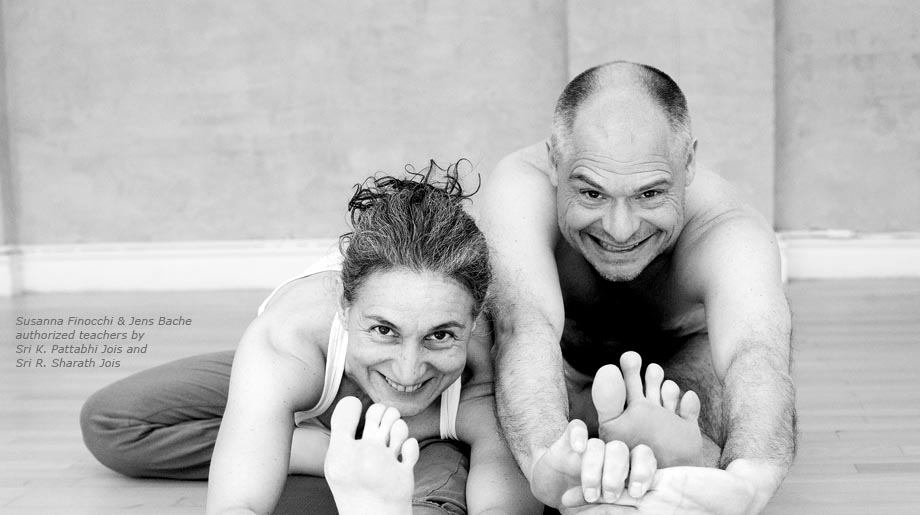
During my trip to Mysore, India, in 2008,  I was happy to meet Authorized Ashtanga teacher Susanna Finocchi who co-manages Ashtanga Yoga Copenhagen with her partner Jens Bache as they continued their studies at the Ashtanga Yoga Research Institute. I sat down to talk with Finocchi over breakfast at Santosha about her Ashtanga evolution. Here's an excerpt* of our conversation:
DC: Tell me a little bit of your path. You are an herbalist and were assisting your mom who is also an herbalist with whom you had a shop in Rome. Then you became an ashtangi, coming to Mysore every year…now you're an authorized teacher in the tradition of Sri K. Pattabhi Jois…
Susanna Finocchi: I just started yoga because I liked it. There was no other reason. I started out of curiosity because a friend said, 'try this yoga, you sweat….'
DC: When did you first come to India?
SF: I was here in Mysore completely as a beginner in '95, not even practicing 2 years and then again in '96. I was very surprised by the atmosphere of people. I was like 'Alice in Wonderland!' People were here staying abroad and far away from family for long periods of time.
DC: What do you love about teaching?
SF: To see people grow. It's like that story of a little duckling becoming a swan and then you can fly.
DC: And I imagine you've taught 100s of people by this time...
SF: Yes, in the school there are almost 50 Mysore students every day.
DC: When you are here in India, do you miss teaching?
SF: Now I start to feel the itch on the hands for teaching. But in the beginning it's very nice to just be a student and not have any responsibility, and to find time for myself and Jens, of course. To find time to just to think.
DC: Do you like doing a lot of [hands-on] adjustments?
SF: Yes, I like adjustments. Every time I come here, I adjust my ideas and my process and teaching approach. Sharath gives me very nice input. On this trip especially I had this thought to have the student try to catch the poses by themselves a little more. I like giving adjustments because I think it's effective but I think it's important also to give the student space.

DC: When students are struggling with that, do you make any recommendations? Do you think Ashtanga practice is a complete package to handle those strong feeling?
SF: There are many, many, many obstacles. I think it's a very personal journey. Somebody could be frustrated, somebody could find it easy, somebody can get sick or have pain and stop because they think yoga isn't supposed to bring this up. Or you can have someone who [does] not have an easy body [who meets] yoga much earlier than someone who has an easy body because they have to find another opening. If yoga is a self-realization path, then these things have to come up. I think there is a lot of justice in this practice.
DC: Justice?
SF: Justice in the sense that, sooner or later, everyone finds obstacles. Maybe you have such a flexible body and do unbelievable things but this doesn't mean anything.
DC: What do you think are the best supporting practices for the asana practice?
SF: Yama and niyama. It's about respect, love for other people, to care about other people, peace, none aggression, internal happiness, not this craving about another asana. And to be pure in our search.

*If you are interested in the full transcript of this interview, please write me at deborahrcrooks@gmail.com

Tuesday, November 11, 2008

Mysore: Music & Chocolate

*post updated 11/13
Yes, there is good chocolate in Mysore and I live right around the corner from the tiny store-front that sells all manner of common Indian groceries, bottled water, as well handmade foil-wrapped bars of white, milk, dark and chocolate in unadulterated versions and variations such as cardamon, coconut, or fig date. Yum! Ganesha's Chocolate Stand has been the place to meet for a group of some of the other musician/yogis who are practicing here now and came together to play for a party (our debut is later tonight) and we decided to call ourselves The Chocolate Stand for our meeting place. It's comprised of Lasse Honkonen (Finland) on guitar, Jonathan Borin (San Francisco) another guitar, me singing and Chris Kitisakkul (Thailand/London) on tablas. He's taking tabla from the brother of my Carnatic singing teacher here. Our teachers might roll their eyes at how we're incorporating our classical lessons, but it's been a very fun lark. Note a bit of the party below (yes, we wrote a Mysore yoga-specific song).