-->
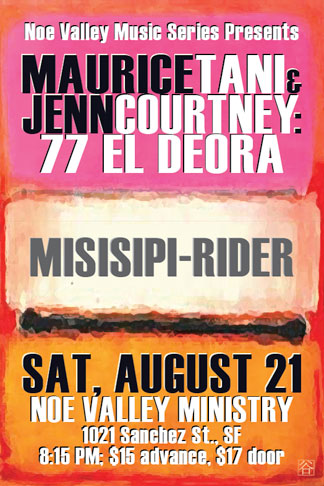
I first saw 77 El Deora about 5 years ago at one of El Rio's annual backyard BBQ country blowouts, when the patio is hopping with beer drinking and heel kicking revelers and one is generally reminded it's good to be alive. It was a full afternoon of fine music...but I was really impressed when 77 El Deora took the stage and put its virtual pedal to the metal of its unique brand of torch and twang. Featuring Maurice Tani on guitar and vocals and Jenn Courtney on lead vocals, the band was commanding and large in the way only a tight, well-practiced band with a clear point of view can be. AKA I became a fan, and because the band is hardworking, regularly gigging and supporting other acts, I eventually met Tani at another musical event. After moving to the East Bay and running into him once again at Freight & Salvage where he was trying out some new songs in an acoustic format, I got up the guts to ask him both to help out a song I'd started and for an interview. Tani graciously said yes to both, and amid gigging at songwriter showcases and tribute shows, putting the finishing touches on his latest CD, doing at least one co-write, and getting ready for 77 El Deora's next acoustic turn at Noe Valley Ministry in San Francisco on August 21, Tani answered some questions about his approach to making and playing music.
Q: Your current band is named for a car. Did your love of cars or music come first? When did you first pick up a guitar?
MT: True, the '77 El Deora was a car, but it's usage as a band name is more about the cultural/social manifestation of this particular automobile than the physical nuts and bolts. Here's a link to an article on the El Deora with some info what it means to me:
As to what came first for me, cars or music, cars may have come just slightly ahead, but they were certainly nose-to-tail. In fact, cars, guitars and girls all hit about the same time — we're talking puberty here. My roll model was an older teenager down the street who had a gold Fender Jaguar, a Super Reverb, drove his parent's black 440 ci '65 Superstock Dodge Coronet and had a girlfriend that my young, hormone-soaked brain thought was the sexiest woman on Earth. This guy had the whole package and he took me under his wing, teaching me to play rhythm while he practiced melody lines, and letting me tag along to rehearsals with his band. He also got me into places I was too young to go, taught me how to roll a joint, and how not to be a total moron with girls. He was my mentor for all the things one could never ask one's parents or teachers about, and the guitar was at the center of it all.
Q: You're now known more for playing honky tonk, country & Americana roots, but you were a part of both Zasu Pitts Memorial Orchestra and Big Bang Beat. Were you writing other music on the side when you were active in those projects?
MT: At first I was but regrettably, after a few years, no.
The ZPMO & BBB period was sort of a runaway train. The first few years ('83-'85) were when the band was highly visible, playing monthly 2- and 3-night stands at Great American Music Hall and doing a lot of local private stuff. I was able to treat it like a fun, side-project and continue with other stuff. But as ZPMO transitioned into BBB, the public shows gradually fell off and the corporate travel picked up to a furious pace, eventually sucking up all my bandwidth for writing and performing my own material.
That's not to complain. It was a great gig. Good money. Travel was light and always to nice places, then right back home — no driving around the country for weeks at a time. And it was a blast to sing in front of a large band with back-up vocalists and a horn section in large rooms, but after 15 years I was burning out. I felt more like a corporate contractor, like a caterer or a florist, than an artist. By the late '90s, I built up a side career as a freelance visual designer and by 1999 was able to quit my "day job" in the band and left to go back to writing and playing my own material.
Q: You're the main writer (I believe) for 77 El Deora. Can you talk about your inspiration for the project and perhaps your approach to songwriting in general?
MT: I'm inspired by all sorts of stuff that finds its way into the songs, but a major inspiration for the material I write for Jenn and myself is Jenn. The songs fit her so well primarily because they were made for her to sing. A few are taken directly from her life, but generally they are designed to fit her as a fictional character based on herself.
The material I write for 77 El Deora generally falls into two categories I think of as "Romantic" and the "Trailer Park Operettas." To a large degree, "romantic" should be fairly self-explanatory — though "romance" doesn't necessarily mean "love." My definition is more of an idealized vision of a given subject.
An example of a straight up love song from the 77 El Deora album, Sirens.
The TPOs are a class of songs that are usually (hopefully) fun lyrics, often written as duets for Jenn and me to play a sort of battle of the sexes against each other. I often describe them as scenarios one might see on Judge Judy (trusting woman loans deadbeat boyfriend money. He never pays her back. They break up. She wants the money. He says it was a gift...).
An example of a trailer park operetta from the 77 El Deora album: Hammer & Tongs.
I approach writing primarily as an attempt to hold my own attention. I'm like most people. When I'm listening to music, or enjoying just about any other form of art, I want to be drawn in and engaged with the protagonist. I want to wonder what's going to happen next or anticipate the other shoe dropping. There are a lot of devices one can use to make songs interesting. I like to use a cinematic approach. The idea is to set a scene and gradually reveal the focus of the song.
One of the things I like most about country music, as opposed to most other pop music genres, is the use of the linear form. Pop music, and I include every commercial genre in that category, is generally based around a hook, usually found in the chorus. Verses commonly lead the listener to the chorus, then the form repeats, sometimes with a bridge to break things up or add. In many pop songs, you can change the order of the verses and the song remains the same. One can think of this as a star format, with each verse a point leading to the same center chorus.
In the linear form, verses work like chapters in a story. As the song progresses, the new aspects of the story are revealed and the meaning of a repeating chorus may change. It certainly isn't exclusive to country -the form dates to the dawn of music, and not all my songs utilize the device, but I use it in varying amounts in many songs. An example in a classic country format from the Calamity & Main album, Honky Tonk Heaven.
Q: Do you have a regular writing discipline/practice?
MT: I don't have a regular writing discipline/practice. I wish I did, and I envy those who do, but it doesn't seem to work that way for me. Writing is usually a struggle. Songs come to me in pieces, a few lines at a time at most — often in the middle of the night or as I wake. Sometimes while driving or walking. I can't make it happen. I am chasing the muse and she let's me catch her just often enough to keep my hopes up.
Q: Have you ever thought about taking/have you taken your project to Nashville or abroad?
MT: We've been to Europe and up and down the coast, but when someone mentions Nashville to me, it's usually in the context of chasing some sort of country music business deal. A publishing deal. A recording deal. A song placement deal. And I have no idea how to approach that in a way that wouldn't seem like an exercise in futility. I don't rule it out...but it's not something I have actively pursued since I was in my 20s.
Q: Do you think there's a uniquely San Francisco take on Americana/Roots/Country music?
MT: No. Not really. Certainly, some good stuff comes out of here, but I think of it as more a part of the broader California style than uniquely Bay Area. But perhaps this is like the locals never thinking they have an accent.
Actually, I'm almost surprised that we have any country music in San Francisco at all. Our local mainstream and alternative media doesn't pay much attention to country music of any sort — commercial, alternate or traditional. Not that long ago, one of our local alternative rags (SF Weekly?), decided to simply eliminate their already combined country/blues/folk listings section from their weekly entertainment calendar, while we had no dedicated country music radio station in the Bay Area —just a handful of shows for a few hours each week on public radio. And yet that same summer, the biggest selling records and concerts in the Bay Area were mainstream country acts. There is interest in the genre, just not from our local media.
We now have a full-time country music radio station — though it is the complete antithesis of anything "uniquely San Francisco." "The Wolf" must be programmed directly from the corporate mother ship. No Music Director who knows anything about the Bay Area demographic would hand us the dreck that this station passes off as commercial country radio: the anthems to xenophobia, America right or wrong, foreign cars suck, city dwellers are arrogant, the 'Us vs. Them' mentality... Real God-fearing Americans. Real Christians. Real, down-to-earth people with real moral values as opposed to the phony elitists. It's a pandering celebration of defiance to a perceived threat to the honest, middle-American Heartland way of life. "The Wolf" station celebrates everything that is anti-San Francisco.
Of course, the brightest light for Americana/Roots/Country music in the Bay Area has been Hardly Strictly Bluegrass, but that huge festival hasn't included any local performers for years. If there is a uniquely San Francisco take on Americana/Roots/Country music, the organizers of HSB are hardly interested in it. It would certainly help the local performers who are down in the trenches all year trying to get a little traction for this genre to have a little access to the hundreds of thousands of people that attend the festival over the three days — just some small stage, down at the end of Speedway Meadow. We'd do it for free. Are you listening out there Mr. Hellman?
Q: You've done a lot more acoustic performances this year. Any thoughts on scaling the band for acoustic shows over electric?
MT: Indeed. We have concentrated on the acoustic side heavily this year. As much as I love to rock, the acoustic shows have opened up a new range of venues and listeners and provided a new platform for the material that lets the songs shine, especially lyrically. Luckily, I don't have to choose between them. I intend to continue doing both.
In terms of scaling the band for performances, from the beginning the band has almost always performed as a 5-piece. Adapting to acoustic sets has seen us scale both up and down. 77ED bassist Mike Anderson and I initially started playing in an acoustic duo format last year under the pseudonym Briggs & Stratton as a sort of R&D effort, deconstructing the electric material down to the form that has become what we call the "Hell Yeah! Turn it Down!" acoustic sets. Ironically, the major acoustic shows we have been doing this year have had the line up expanded to 6-8 people on stage. The major new flavor in the pot has been the inclusion of pianist Randy Craig for these shows.
Q: Anything new in store for the Noe Valley show?
MT: Besides a new song or two, this will be the first SF show with the expanded acoustic band, so this will be the first chance a lot of folks in The City will have to see this configuration — the Freight & Salvage and Strings shows having been in Berkeley and Oakland, respectively.
This City vs East Bay issue is such a one-way street. It would appear that the Bay Bridge is significantly longer in one direction than the other. People in the East Bay come into town daily and even twice in a day but many San Franciscans (and I say this with love as a native, born & raised San Franciscan) treat a trip over the bridge as a major excursion requiring a house-sitter, updated passports and arrangements with the neighbor to water the plants. I lived in Manhattan for a while and it was exactly the same relationship with the other boroughs and Jersey.
Q: You've a new Cd in the works too—will it be more acoustic in feel to reflect recent performances? What can listeners expect?
MT: The new CD will be a blend of acoustic and electric. A little more slanted to the acoustic side than the past two albums considering this year's efforts, but there will be a wide dynamic range of material, including plenty of the more boisterous, electric stuff — though the line between electric and acoustic is much less defined on the recordings.
I have always looked at the recordings as something a bit separate from what we do live. They are a different take on the songs. A chance to interpret them in ways that are perhaps impractical to do live. There are songs on the albums that we don't play at shows. And the recordings also give me an opportunity to expand the instrumentation and bring in people I like to work with that wouldn't normally be an option for live gigs. The new cd will be similar.
Q: And for the guitar aficionados out there, what's your favored instrument of late and why?
MT: I've never been that much of a gear head. I'm just not that fussy about equipment. Not to get too Buddhist about it, but desire is a source of suffering. After a certain point, I don't think having more tools makes the work any better. I don't believe that any great record was great because of a specific piece of gear — be it a guitar, amp, mic, or effect. Great music comes from great performances of great songs. Great gear isn't anywhere near as important as lyric, melody, rhythm and performance.
I tend to simply work with what I have. When I was doing a lot of touring, as often as not, I was using rental amps. Getting consistent tone from them was a struggle. Every amp, stage and room was different. I eventually found peace when I decided that I would simply surrender and work with whatever the rig was best at doing. Clean, dirty, dark, bright — what ever it did best, I would embrace it and make that sound work in the format I was playing. It's like dancing with a new partner — you have to adapt to each other. I think it makes you a better dancer. As the rhetorical question about marriage goes, "Would you rather be right or happy?"
So, I have mostly guitars I have had for decades. I have built some of my electric guitars and basses myself, but they don't tend to leave the house much any more — only due to their irreplaceable nature. The electric I'm seen most often with is a Strat I had built by Modulus back when I was touring a lot and had become nervous about having the dream guitar I had spent months building damaged or stolen. The idea was that I would finally treat myself to the best production guitar I could afford, that could be replaced if something happened to it. It's quite a nice guitar but it's just a guitar.
Soon after, I needed to replace the back-up guitar I used on stage. So, I bought a cheap Japanese Fender. That guitar would sit unplayed on one stage after another for weeks at a time until finally needed while the stage tech was changing a rare broken string on the Modulus. I'd pick up the spare and think to myself, "What a perfectly playable guitar this is! If that Modulus is worth over $1000, this $250 guitar is worth at least $950!" When I was a kid, cheap guitars were nearly unplayable. Today you can buy a cheap guitar that is 90% as good as the best guitar for 10% of the price.
I use an Ibanez acoustic-electric for the acoustic shows, but I'm not very particular. Once an acoustic guitar is plugged in, they all tend to sound the same. Nearly all use the piezo pickup system which I don't love, but it's a serviceable compromise for on-stage. I mostly look for low action and a moderately wide nut. My recordings are done with a mic and conventional acoustic guitars.


)
)


