Showing posts with label Hayward. Show all posts

Monday, December 3, 2012

Artist Interview: The Pete Ahonen Experience


Energetic, funny and passionate about making music, Oakland songwriter Pete Ahonen has been captivating audiences throughout the San Francisco Bay Area with his own brand of outlaw country/folk rock. Upon the completion his debut CD “In the Blood” (Lost Monkey Records), the East Bay native is poised to take his music to a wider audience. Ahonen recently answered a few questions about his influences, writing process and the making of “In the Blood.”

Q Who do you count as major influences?

PA: Mason Jennings, Tom Waits, Townes Van Zandt, [and] Shane Macgowen.

Q When did you write your first song? What's your writing process like?

PA: I learned to play guitar when I was 10. My neighbor was a church music leader and he taught me some stuff. Before I knew it, I was just spending a lot of time sitting in my room alone playing guitar and messing around with stuff to see what I could do. Around the age of 13, my musical cherry got popped, I guess you could say. I started listening to Freddy King and got really into it. I ended up writing a little blues shuffle about a girl who didn’t exist — and that was it.  I was hooked.  I was pretty self conscious about my voice at first, and then one day someone showed me Jimmy Hendrix. I learned that he was self conscious about his voice too, but I was so blown away, not only by his guitar playing — he was a killer songwriter, too.
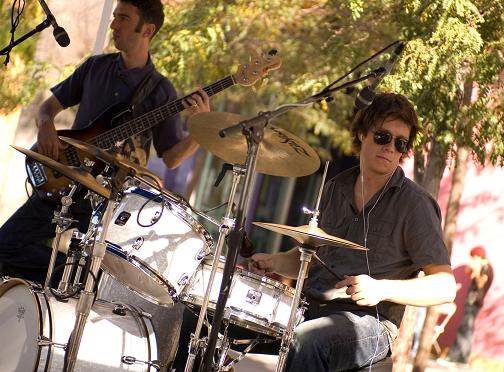
Pete Ahonen and bassist Andrew Gibson.

I always enjoyed being creative and writing short stories and stuff. I could play guitar pretty well so I started turning those short stories into little ditties. My writing process is kind of like... I sit down, try and cultivate a mood... I’ll pull out a snippet of a line I wrote down while I was walking around somewhere, and try to channel a vibe or a feeling about it. If I sit down with the intention of writing a song, it’s bullshit. Nothing comes out. My muse is really about keeping myself fed with information and experience in order for something to come out. I spend a lot of time just sitting on my porch, and my neighborhood is kind of crazy so I get a lot of inspiration just from that. It could be a couple having a fight, or a drunk guy having a good ol time, or this a lady whose always looking for change in the gutters. At that point I’ll kind of hear the guitar or notes in my head, so I’ll try to hum a line and then it just sort of happens from there. And then other times, I’ll be trying to write a song for like two years and I just can’t get it.  It never gets finished. You kind of just have to let it come naturally.

Q How did you go about selecting the songs for this CD?

PA: Kind of like the song writing process, it’s in the song itself. The song will tell me that it’s the one for the album. Before going into the studio, I had a lot of songs in the hole, or at least parts of songs. And I think a theme kind of presented itself during the recording process. We recorded the first song, for example, and we were all like, wow,  this is a really special tune. And going in... I had no idea it would turn out like that.  I really think the musicians I play with are a huge part of that too. Every song we recorded had a different theme and the content wasn’t really the same, but in the end the ones we picked felt like they were from the same tribe and they were meant to be together on the album.

Q Describe the recording process for you? Did songs take on different directions in the studio?

PA: I think the songs took on a bit of a different direction, especially musically. The lyrics, and the tone was basically pretty dialed in already, but musically we would sharpen different things to kind of add to that mood. But I think that’s what happens when you work on something creative, everyone has an idea of what something should look like in their head...and your songs can be shitty if you go into it with that approach. You have a general idea, but it doesn’t mean anything until you put your hands on it and start working on it, and the smallest thing can change everything. You have to be flexible and open to where it can take you. I think it depends on what you value, and what you’re after. When you’re singing with intent and emotion and you say ‘I want to play my song well’, and you do it with feeling - maybe there’s a squeak, or something’s out of tune, but it doesn’t really matter. To me, songs are more about the experience and not about it being perfect.

To buy "In the Blood" and find out about Ahonen's upcoming live shows, visit: http://peteahonen.com/

Tuesday, March 13, 2012

Interview: Producer/Musician/Studio Owner Mike Stevens Talks (Recording) Shop

Several years ago, while in search of a new drummer, I was given Mike Stevens' name by both a band mate and a producer. It took some time to reach him because he was busy playing so many other sessions and gigs. After playing one show together I understood why: he's both a rock solid and versatile drummer and easy to work with. I've since worked with Mike on a number of recordings and he's since opened his own recording studio, Lost Monkey, in Hayward, CA. In between his sessions, he answered some questions about his approach to recording.
   Q: What makes a great recording session? What ingredients have gone into your favorite and/or more successful sessions?
MS: What I've noticed is that it's all about the performer getting out of their own way. It seems like I'm always hearing from people [how] they love so much about their iPhone rehearsal recordings, and when they step into the studio to record things more cleanly, they don't like it. I know it's not because the equipment in the studio makes them sound worse. What I've learned from my own experience and from working with other artists is that there's this mental switch that happens when you step into the studio. There's a lot riding on it. We put expectations on our performance and the outcome... often times an artist is thinking about trying to recreate that magical rehearsal session. To me, that breaks the performance because that's the opposite of the mindset you were in when that magical rehearsal happened. You were just there... doing your thing... no expectations... no pressure. I honestly believe that when you can step into the studio with that attitude, you are closer to where you need to be to get that magical take. When you can't, you just push yourself farther from it.


Q: How important is gear? Do you have any preference or thoughts on vintage vs. modern gear? As you set up Lost Monkey, what were must-haves and why?
MS: Gear is important to the point that you need something to record with and on to. Aside from that, there have been many great recordings made with gear that most audiophiles and engineers would laugh at. It kind of goes back to the performance attitude I mentioned before. That is far more important to me than gear. [It's] important to remember that most music listeners aren't musicians or even hard-core audiophiles. They want an emotional connection to a song ... and they often can't even say specifically why they do or don't like a particular track. I believe the delivery and songwriting is what pulls them in ... not the tones. After all that, different gear just gives you different colors to paint the music ... and those colors range from vintage to modern to lo-fi to pristine. For example, with all the nice mics I have to put on drums, sometimes I reach for the old rotary phone handset I have wired up as a microphone. It sounds like total lo-fi shit when you listen to it alone, but when you blend that with the other drum tracks it can give the drums the right amount of edge they need for a particular song. I really like having variety. I often pick up things as I come across them. My main must have for Lost Monkey was as many input tracks as possible so I could record bands live... to get that nice, tight energy. I'm running 16 simultaneous inputs using a Digi002 with an ADAT expansion. I have an 8-channel Tascam board that I use for preamps going to the ADAT and a few nice tube preamps I can use as well. I like the set up. It does well... would it be different if I had an unlimited budget? Absolutely. I’d probably have a 24 track tape machine and a vintage analogue console and preamps coming out my ears, because I personally like the colors that kind of gear brings... but I'd also keep my current stuff on hand. I like options.

Q: What producers and/or studio owners have particularly inspired you?
MS: I’ve been on a lot of sessions... on both sides of the mixing console. Through that I’ve seen it go down so many ways. I’ve found that there's something to take away from every experience, whether it's a new way to do something or a how not to do something.
Honestly, every single producer, engineer, studio and artist has taught me something. I observe and absorb a lot. I try to take everything in and incorporate it into what I’m doing. I find most of my inspiration [from] producers and studios that lean a little more towards that old school approach to recording. You know, getting a track down before you beat it to death and strip any and everything human out of if. I like it when a producer let's the recording breathe instead of beating it into submission. A song is a living thing after all, and always serves you best when you let it be what it's trying to be.

Q: Other than artists you're recording and/or playing with, what/whose music are you listening too? Could you name three of your favorite albums of the past decade and why?
MS: I listen to everything... almost. And I listen to different things in different ways. I like that 10 people hearing the same song can hear 10 completely different things. Sometimes I listen to albums for the production. Sometimes I'm studying the drummer and sometimes I actually just like the song. I really like Wilco's production style and the chances they take in that respect. Glenn Kotche is an incredibly creative and tasteful drummer. Their latest album "The Whole Love" is great and I enjoyed listening to it from all those different angles. Also, I’ve been checking out Adele recently. She's obviously an amazing singer and I find some of her less standard arrangements really refreshing. Again, I pull inspiration from all sorts of places. I can learn a lot from a song I don't even really like.
Find more information about Mike Stevens and Lost Monkey Studio at http://lostmonkeystudio.com/