Showing posts with label mysore. Show all posts

Saturday, October 4, 2014

Benefit for Operation Shanti in New York City, October 9, 2014

In 2003, Tracy Kunichika traveled to India and started planting the seeds for what would become Operation Shanti, an American-based non-profit that seeks to provide basic health care and services for the country's poorest residents. Since that time, OS has grown to encompass a shelter, services for those suffering from HIV, and programs for the homeless in Southern India and beyond.
I've known Tracy since she started Operation Shanti, and have volunteered a bit for OS when I've visited Mysore, and am in awe of the organization's work.  If you're in New York on October 9, please consider attending a Fundraiser and Silent Auction for Operation Shanti at the George Billis Gallery:

Tuesday, January 31, 2012

Keeping it local


The Mysore yoga community is inherently tight even if you're being low-key about your social interactions. Inside the studio, you practice inches away from one another. Outside, you literally rub shoulders with other students while drinking your post-yoga coconut. Three different friends lived on my short little street who I could easily call on. I became acquainted with two neighbors, long-time Mysore residents, who ended up knowing a lot about my life after two months of daily chit-chat amid our comings and goings. As such, I really didn't walk out of my door without being acknowledged and acknowledging someone else, if not stopping every 10 yards to have an actual conversation.
Re-entry into Western life after a couple months of this lifestyle always entails a bit of withdrawal from effortless community involvement. Interacting with others, in person, while living in the states takes a much different level of planning. Much of the past few days have been checking in with my stateside friends... and realizing how much we must drive to see one another.  
Which is partly why I'm starting to host a new Local Music Vibe Meet-Up in Alameda where I live. Founded by music lover and evengalista Shelley Champine, Local Music Vibe is all about connecting people to the live music around them. The idea of the Meet-up takes it another step by connecting other musicians and music industry folks to one another in their own backyard. The Alameda Meet-up kicks off next week, Feb 7 @ 10 am at The High Street Station. If you're a local musical sort come on down and introduce yourself.

Alameda Local Music Vibe Coffee Meet-Up —Feb 7 10 a.m. 
1303 High Street
Alameda California 94501

Tuesday, January 24, 2012

Mysore: Looking West

A friend, cognizant that I was leaving town in a few days, asked if "I'd checked out."
"I hope not!" I didn't want my 'last' week in Mysore to be any different than the other weeks. That is, I didn't want to cram in everything I hadn't done yet, go on a last-minute shopping spree or put too much pressure on achieving something more in practice. My intent was to be in the moment.
In truth, it's been impossible to not feel the clock ticking down as I go about arranging a car to the airport, assessing what and how much of my things I'll pack and carry home and deciding if I'll leave a trunk of household items in storage here that will be useful for any future trip(s). The question of when and if hangs in the air. All I know is that even as I'm looking forward to being home with loved ones and playing when I get back, this place, my lifestyle here — sleeping specific times for specific practice times, practicing in the shala, eating South Indian food, the sounds, being surrounded by the community of other semi-migratory students for a period of time— has become a bit ingrained. It's so different than my life in the States, but here it is, equal and different in its own way.  So, today, not so surprisingly, I worked through a variety of feelings in practice  ("Too much emotion," Sharath would say), the irony after two months here being not feeling so yogic! But then that's why they call it practice! Every day it's a new day with its own unique rasa.
After I walked down to Gokul Chats to have my tea and dosa outside, in relative quiet, and wrote a bit before turning on my Kindle (can I reiterate how GREAT a Kindle is for this kind of travel?) and the day really got going. Truth be told, I haven't been studying up on The Yoga Sutras of Patanjali (recommended though!) or the Gita but instead have been loving reading the Keith Richards book Life.  It's hilarious. A tale of adventure, the Blues, rock and roll, perseverance ...and ultimately following one's one unique and often irrational bliss. Yeah.

Thursday, January 19, 2012

Mysore: Chocolate & charity

I live down the street from "The Chocolate Man" aka "The Chocolate Stand" or 'Trupti's," a much-loved and very packed little storefront whose proprietor, wife,  son and daughter-in-law roast coffee, special-order pasta, organic jam and soy milk for Western tastes and have a little business making their own chocolate. The 40-80 rupee bars, coming in flavors such as chocolate-cardamom, dark chocolate almond and chocolate coffee, stave off many chocolate Jones. Otherwise, the chocolate in India isn't quite up to US or European standards (albeit Cadbury has a large presence here) and tends to look but not taste that chocolaty. That isn't to say Indians don't love their sweets! Sugar dominates cups of chai and coffee and is whipped into plenty of ghee-heavy local delicacies. The price paid is a high rate of diabetes (India leads the world in number of people with diabetes) and tooth decay.
Most likely due to my mom diligently giving us fluoride as children, I've made it through my life thus far without getting a cavity.  When I went to the dentist here they reminded me to rinse, but opined I didn't need a cleaning 'unless you insist.'
This week I've been back at the dentist, albeit helping take some of the children from Operation Shanti who need dental care to their appointments.  These children spent much of their young lives on the street before coming to Karunya Mane, OS's shelter for children in need, and the concept of a toothbrush is fairly recent to their thinking. As such, many have cavities already— only one girl of the few I took to the dentist Wednesday didn't need a filling. Instead, she received a cleaning and a good talking to about brushing up and down.
"They are very cooperative," the dentist noted as the last one got up from the chair.
And they were! As well as surprisingly joyful and easy with themselves. They loaded into the rickshaw with me, holding on tight as we bumped along, and stuck their noses to the wind like dogs in a convertible, inviting the sounds and the views of the fields and roadside sheds we passed selling meals and puffed treats and chai. I marveled at how wise and wonderfully in the moment and far beyond their years they seemed. They took their turns in the dentist chair without whimpering at the drill, shrugged off their procedures like it was no big deal, and delighted in my iPhone photo album as we waited in the lobby.
"Friend?" they asked, pointing to photos of my loved ones in the states. "Friend," I said. Every time a photo of a friend's child came up they jumped, cheered, clapped and smiled.
Back home at KM, they clambered out of the rickshaw, smiled and waved to me, and were off to their beds without a backward glance. 

If you'd like to volunteer with Operation Shanti,  a 501(c)(3) nonprofit organization, or donate to the organization, please go to http://www.operation-shanti.org for more information


Sunday, January 15, 2012

Mysore: Rangolis & Running Bulls

During Pongal, a festival of harvest celebrated over four days in January in conjunction with the solar calendar, cows across India are washed and painted, decorative chalk patterns painted in every driveway and families gathered to feast on seasonal dishes. Pujas are offered, animals blessed, and neighbors visited. "It's like Thanksgiving," Anu, the much-love proprietress of a popular cafe in Gokulam, explained, 'it's about being grateful and sharing." 
Anu was fairly spontaneously leading a group of Westerners to a small town, Vaddhara Hally, about 40 minutes drive from Mysore. While the city was full of painted cows and rangolis, we'd be able to see the most tradition Pongal celebrations in the small villages whose residents are more closely connected to agriculture. A day earlier she had met a village leader, a colleague of one of her friends who worked in Mysore, who welcomed us to join his village's celebration.
The festival kicks off the beginning of Uttarayana, when the sun moves northward for an auspicious six month period, and the traditional farming season comes to a close.  As such, prayers are offered to the crops, and the third day of celebration, Manji Pongal, is dedicated giving thanks in particular to the cows and buffaloes who help tend them. Included on this day is 'Manji Virattu,' the tradition of washing and decorating the bulls then leading them to jump over fire.  This Indian-style 'running of the bulls' was what we were driving to Vaddhara Hally to see. But we got much more than that.
While we weren't far from Mysore, Vaddhara Hally had perhaps never been set upon by 18 Westerners like this. As our cars drove into the town center where the cows were being readied seemingly every resident came out to look at us. They were the complete opposite of jaded. That is, we were immediately a source of interest, led through the rows of houses (made from stone and mud much like adobes of the Southwest) and followed closely by children. As word spread, more people came out of their homes.  A woman asked us to come in and we were given a tour of a clean and modest home where one room was given over to a sheep, and another room had a hole in its stone floor where seeds and masalas were ground.
We were then taken to the village leader's home where we filled the living room and his wife served us lemonade, cookies, bananas and the small packets of a traditional mix of sweets, seeds and roasted legumes. Outside, a dozen children peered through the door waving. While seconds earlier, we were strangers, now we were honored guests.
By the time we finished our refreshments,  the cows were ready. Back at the village center, drums were sounding. A holy man performed pujas, blessing the cows, the jumpers, and us with flame and a sprinkling of water. Then we followed with most of the villagers as the herd of cows were paraded to the edge of town and the beginning of the fields. A fire of shrub and palm was lit in the road and fanned with more palm fronds. As the villagers cheered, the men began to run over the fire with their cows. Most were barefoot.
Even though we expected to see this,  it was truly an amazing spectacle. By the time the last cow had jumped (a few balked inconsolably at the fire's edge), the sun had set. A girl gave us ashes from the fire so as to smudge our foreheads, another blessing. Then we and the rest of the villagers walked back and to many thank yous and hellos and goodbyes were waved back to Mysore.
 

Friday, January 13, 2012

Mysore: Hoots, honks & hollers


It is hard to imagine the number of tracks a recording engineer would need if he or she were to try to replicate the sound of India in the studio, layer by layer. My experience of the aural landscape in India is like none other, an incrementally building multi-part orchestra of human, avian, animalian, mechanical and meteorological hoots, honks, scrapes and blares that builds to a sometimes intolerable thickness. I’m especially struck by this on rare mornings when I sleep in (rarely past 7am so as not to disrupt the pattern of early morning rising necessitated by the practice schedule), and can sit and listen a while before entering the landscape with my own set of parts. Today, Saturday, the first sound to my ear is that of a maid sweeping the walkway, a distinctive sound in of itself, as here the brooms are made of sticks that scrape the pavement in a way that is both sharp and oftentimes wet sounding. Underneath that layer is the low moan of wailing coming from the Muslim temple. There are at least three different birds calling: one crow, something like a dove and a small songbird. Two ubiquitous sounds — a moped's whine and a gate opening and closing — arriving solo this early in the day, sound almost forlorn, as they will be joined by a larger chorus of gates scraping and scooters beeping as the day busies. More doors closing by the neighbors upstairs, a rickshaw's engine clank and clatter, and a flute's call, recorded or being played by an early morning rehearsal, float down the street. The voice of a radio announcer speaking Hindi is a distant murmur. Then, the downstairs neighbor dog begins to bark and growl to be let out, and more gates open and close as people up and down the street begin to rise and go about. Somewhere else, water is at first run from a tap, then poured onto the ground. More birds, flying overhead, chirp and call. In the evening, the sound of parrots will become more frequent. Mid- to late-afternoon, there's a largish, brown striped bird that half hoots, half coos in the high branches of the trees. 
Listening as I am now, the reason much of Indian music is written to be played at certain times of day, each raga having a distinctive rasa that suits or emulates the color and mood of the hour, makes sense anew. The morning here is so the morning.
Second by second, the pace quickens. One of the Western-model cars, a more prevalent sight this year, whirs a little too quickly down the narrow street, which doesn't comfortably accommodate the vehicle's size and speed. Footsteps of a person walking hurriedly, the heavy hoof falls of a cow ambling down to the house whose owners will let it in the gate to graze on their greenery, and a waking person's cough, pipe in. In an hour or two, the street vendors, Mysore equivalents of door-to-door salesman, will push carts full of vegetables, plastic-wares or fruit, calling out the name of their wares. There is no need to knock on the door. If someone wants to make a purchase, doors are opened to the caller and negotiations made over the front gate. I walked past one of the vendors yesterday, pre-sale and in full advertising mode, and was struck at how deep and rich a voice he had from his repeated calling. I imagined his singing voice would be pleasant...provided he chose a new song.
I should add that I'm staying in a relatively quiet and upscale neighborhood. My doors and windows are secure, the walls of the house cement. I don't know if anyone ever thought to mute all the sounds here, volume seeming more a matter of tolerance and might (if you can't hear, turn it up seems to be the approach, especially to televisions, another sound that's starts streaming from many households in the evening). 
Out on the main streets, the sound intensifies, with buses, horns, people walking, talking, being. On 'thin-skinned days,' as I call them, when practice has felt taxing or opened me up past comfort, it's wise for me not to venture that far out. Downtown, every sound is turned up, in double-time and mult-part. Yesterday, drinking chai with a friend before a kirtan which would waft a layer of chanting voices over the neighborhood, a large truck drove by only to have a tire blow out in a loud punctuating pop. Another chorus of beeps and honks went up from passing traffic, along with a crowd of voices closing in on the truck to vociferously consult and opine.
It is rarely if every silent here, though there are ports of calm. Waking in the deep of night, sounds are fewer and further between. Wind in the trees punctuated by the occasional sound of a strange, not quite identifiable animals—perhaps it's sparring feral pigs, or a street dog fighting a small animal, or cats in heat? I don't really want to know. 
The yoga shala is a relative oasis, full of its own unique acoustic blend of breathing, the occasional murmur of the teacher's voice when addressing students, sounds from outside getting in to provide context: dogs fighting, coconuts being split, children on their way to school, and the steady rhythm of rickshaws coming and going. 
It has been less than an hour since I started this post, and the first street vendor is already walking through the neighborhood calling. Far away, a vehicle, or maybe a train is blowing its horn in a low constant. Another car or truck is backing up, emitting a tinny musical recording as warning. The day is very much on its way.


Wednesday, January 11, 2012

Mysore: Logistics

It's more crowded here than when I arrived. That is today, the first wave of students started at 4:30am and the last student left the studio at 12:15. I arrive 20 minutes before my scheduled time, the second shift of students, and the foyer is packed with people waiting their turn. Chanting classes are pushed back 15 minutes to an hour pending how the student influx goes. No one I know has been granted an extension to stay longer than the study period for which they signed on. The housing crunch remains just that. A crunch.  I mention all this because some days, beyond yoga practice, I wonder where the time has gone, then realize much of the day was taken up with logistics and as many of those have been housing related. At least this week, with some imminent housemate changeover in the works, my other self-imposed writing and rehearsal practices have been squoze a bit.  Added to the standard logistical laundry list of getting water, figuring out the post-office (international packages are sewn together before posting which requires another step in than process), and a making a dentist appointment, has been meeting potential roommates or giving someone else a number to a friend of a friend who might have a room to spare for a couple of days if not two months. And then it has not been uncommon for people to knock on my door unexpectedly, looking for a room. Many people are leaving. Many people are coming.
It's easier and more comfortable than ever to be a yogi in India—the path of other yogis who have come before with their requests for filtered water, WiFi and Western style food has become smooth — provided you can find a place to stay. I suppose it wouldn't be India without the contradiction.
Regarding the dentist, there's surprisingly good and inexpensive dental care here (800RS for a teeth cleaning, walk-in appointments possible). In fact, I've met people who've extended trips specifically to get their teeth fixed. (Likewise, if you're injured, it's relatively easy to get an MRI and complete results within the day.) The dentist office is in a building that also does a lot of cosmetic procedures, another irony, this luxury in the face of the poverty 10 yards down the road.

Friday, January 6, 2012

Mysore: Foodies— From Gobi to Gyozas

What happens once you've been here more than three weeks, is you subtly switch from Mysore-tourist to Mysore resident. Granted yes, this is temporary for most students enrolled at AYI, but many people, minimally, stay on 6 months of each year, and a handful really call it home (albeit as much as one can without official residency). Along with this transition—if you haven't already done it—is an emphasis on home-cooked meals rather than breakfasts and lunches at the several cafes that have sprung up over the years specifically to cater to Western tastes. Given the cosmopolitan nature of the yoga crowd, as well as an acute concern with what one puts in ones body to facilitate practice, there are plenty of options for truly delicious home-prepared meals. While some friends spend their time mastering the local cuisine by taking South Indian cooking lessons, others have simply packed their suitcases with enough condiments from home to replicate meals from their native countries. Seasoned visitors leave room in the luggage for pantry staples like quinoa, nori, tamari and raw cacao that are a little harder to find here (I opted to bring a couple large bottles of Vitamineral Green & Earth to supplement my now-habitual coconut banana smoothies). Potlucks here are a real and welcome treat, as are cuisine-specific dinner parties. Recent and ongoing highlights have included a New Moon Gyoza party, Dosas & Mimosa brunch, a pasta feast and a visiting pastry chef's periodic bake sales including raw and vegan treats featuring imported chocolate and gold leaf. Yum!


Friday, December 30, 2011

New Year's Panchakarma

Ghee, aka clarified butter, elixir of the gods
According to to Patanjali (whose yoga sutras are key tenets of the practice), Sharath noted, there are two different kinds of diseases, those that can be cured by Yoga and those diseases that can be cured by Ayurveda. Ayurveda, the traditional medicine native to India, has preventative as well as curative value. It's also hard to ignore while visiting the subcontinent.
Several friends gave glowing reviews about their experiences doing Panchakarma at Dixit Clinic here in Mysore. Curious, I signed on for the 7-day cleansing treatment based on Ayurveda to ring out 2011 and in 2012. 
Panchakarma (Sanskrit for '5 actions') is basically a de-tox program, Indian style, relying on several Ayurvedic therapies, including oleation, massage, steaming and purging (there's more invasive treatment available pending your condition. I asked the doctor to kindly not make me throw up and was grateful that wouldn't be needed). But this has meant no caffeine and a lot of medicated ghee (clarified butter).
For nearly every day of this last week of the year, I've been taken a rickshaw post-yoga practice to the clinic for ghee drinking, lunch and treatments (my regime augmented by some special treatments for my knees).
Fun, eh?
Despite having to down an intimidatingly large dose of ghee yesterday and the prospect of staying quiet on New Year's Eve, I've enjoyed the experience thus far.
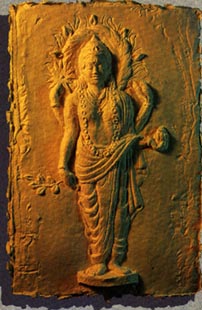
Lord Dhanvantari, the physician of the gods
 In addition to the the health benefits, it's provided a mini-retreat to rest, review and look ahead to the new year. Here's to clarity in 2012, in butter and otherwise!   

Monday, December 26, 2011

Lessons from a Sun Gazer


"Every positive change--every jump to a higher level of energy and awareness--involves a rite of passage. Each time to ascend to a higher rung on the ladder of personal evolution, we must go through a period of discomfort, of initiation. I have never found an exception."
- Dan Millman,  author,  "Way of the Peaceful Warrior" (quote nabbed this from The Daily Love's daily curation)

My neighbor here in Mysore gazes at the sun every day. I see standing him out on his terrace, wrapped in a shawl, pacing a bit and staring east. He's in his 60s, or 7os, it's hard to tell, and is from this city ('of course,' he says when I ask him).  He's out there greeting the day even when it's chilly and the sky is more gray than clear. I always feel cheered when I see him up and about watching the sun.
It hasn't been a comfortable visit here in many ways, which has come as a surprise as it's not my first stint in Mysore. But nagging knee pain has slowed up the process of smoothing out and strengthening of my practice that I've experienced (and come to expect) on other trips....I've got to look at a whole lot of self-judgement and negativity I didn't know was lurking so close to the surface. It's also been, simply, a pain, and I've questioned just what am I doing here.
My teacher reminded we students recently that a lot of the pain [that comes up in yoga practice] is from previous injury or activities. Yoga just reveals them. Oh yea, my knees suddenly remember bike racing and down climbing mountains a little too well.  Still, it took about a week and a half of disappointment about having to modify poses and vacillating between going home early to realize the practice was working on me. It clearly has become not so much about what rather than how. So even though I've wanted to stop, and it isn't all that pretty, I haven't. 
Sharath also pointed out in a recent conference that “Sukha/dukha happiness and sorrow is part of our life. How we can handle these things is very important."
Clearly griping doesn't help. Getting up and doing what one can — celebrating the sun for instance — just might.

Saturday, December 17, 2011

Mysore: Bangles, bindis, bling

Another of the contradictions of India is how so much wealth and poverty dust and ...so much bling, can co-exist.  Beggars with monkeys on their shoulders lead painted oxen on rope and try to block your way until you give them a rupee on a street that is lined with  brand-new multi-story houses. American and Japan made cars attempt to pass cyclists and hand-drawn carts on narrow streets. Even if you're floors are marble, scrubbing one's feet clean is a recommended daily, if not twice-daily, practice.
As a tourist, really, wielding a dollar, I'm automatically a privileged class. A bumpy dusty rickshaw ride brought me near city center and a luxe store full of pashmina, silk, weaves and wall hangings, Kashmir carpets, and silver jewelry. Salesmen served me cinnamon tea in a china cup while I looked a wool and silk pashmina in a rainbow of colors, prints and embroider. Mysore is known for its silk, the fabric made in the factory here according to high standards and turned into colorful sarees and shawls. The selection is amazing.
"All colors," the clerk tells me, pulling out handfuls of carefully folded fabric and unfurling it before me. The drill isn't new to me: the tea, the fabric, the bargaining I remember from other visits— but the selection still boggles. A half hour later, arrangements are made to mail my purchases home.
More tea is offered but I'm on a mission for gifts for the children of Operation Shanti as well as friends and family, and bangles top the list for the girls. Bangles (the colorful bracelets not the band) are hugely popular here and the range of colors, sizes and sparkles matches that of the silk. Stores selling bangles and bindis are as common as tea stalls. Ten bangles per wrist, pashmina over the shoulder,  and a bindi on the forehead and you're ready to go. Bling!

Tuesday, December 13, 2011

Mysore: Pesticide watch

One of the charms of temporary Indian living is the vendors who stroll through neighborhood streets selling fruit, vegetables, housewares, you name it. Their presence is preceded by a vocal call of what they're selling, mostly indecipherable to my ear. But it's fun (and to me, novel) to walk out my door to see what's on sale. And often it's a bunch of vegetables whose names I've yet to learn. But yesterday, I rounded the corner for home and a man held out a handful of red grapes in one hand a plastic box of ...strawberries in the other. I blinked. Was I back at home in California? (CA grows 90% of strawberries grown in the US and I was born in Watsonville where a huge percentage of that 90% is grown).
"Where are they grown?" I asked the vendor, surprised.
"Bangalore," he said.
Evidently, strawberries can be grown nearly anywhere in the world.
But where they organic? He shrugged.
I didn't buy any strawberries in India, and I likely won't.  There are two things I avoid as much as I consciously can in the US that I can't get away from here: plastic and pesticides. There's no shortage of produce being sold in Mysore, recognizable to my eye (cauliflower, carrots, potatoes) and some fairly unique-to-India (drumstick, lady finger, bitter gourd). India is evidently the largest grower of vegetables after China, but a study found 50-70% of those vegetables are contaminated with pesticides. DDT — outlawed since 1972 in the US due to its harmful effects — and other internationally banned pesticides are often detected. And the challenge to growers according to the India Times is not so much not using pesticides, but ensuring that farmers don't use more than the permissible amount.
One word: Yikes!
The good news is that there is an interest in organic food here, too, albeit lagging far behind the consciousness and easy access to be found at home in the States. There are a number of organic markets in Bangalore, but only one store and one weekly green market in Mysore.
I urge you to seek them out!

Saturday, December 10, 2011

Mysore: For the Birds

The beauty of waking up inordinately early is that you see things you would otherwise miss: I routinely scare bats from trees putting my mat out to dry after practice and one morning, walking home, I looked up to see a flock of ibis. I was reminded, via the latest Michael Ondaatje novel The Cat's Table, (which I finished in 3 days last week), that if you're in the desert and thirsty, look to see which way the birds are flying to find water. No, I'm not in the desert, but still—

The ibis were most certainly flying toward the lakes of the city. There are three lakes of note in Mysore: Karanji, Kukkaranahalli Lake, and Lingabudi Lake. Kukkarnahalli, near Mysore University has been a favorite lake to walk around on previous visits. Some people go their to run and it's also a nice place to see birds. I've yet to get there this trip and three different people have told me it's been closed due to... cheetah sightings! How cool is that? I'd love to see a cheetah, albeit I'd rather not be killed by one. And I always kind of laugh at big cat warnings — in Boulder, popular park trails were often closed after mountain lion sightings, and Berkeley has its share of cats prowling through town — not because I don't think they're of real danger, but they're probably always around. It's just when someone sees them they're threat becomes more potent. Kukkaranahalli Lake also has crocodiles so it's clearly a lot more wild and wooly than it appears.
Saturday, I noticed a sign for a Bird Sanctuary while driving through town so Sunday led to the entrance of the Karanji Lake, on the outskirts of Mysore, not far from the zoo or the new, open-but-still-being-constructed Mega Mall. Karanji Lake is the centerpiece of the Sanctuary's action and there we saw the aforementioned ibis in a tree as well as herons, egrets, bee-eaters, eagles, peacocks, the Indian equivalent of a bittern, ducks, cormorants,  and fish. It was lovely, even if, as foreigners, our entrance fee was doubled and a tariff was placed on cameras. So be it. It felt for a few hours we were far from the city.

Monday, December 5, 2011

Flowers and Rickshaws


There’s a young man, Mahesh, who sells flowers outside the shala each morning. There are countless people selling these garlands of jasmine, kanakambaram and roses that people offer at temple or with which they adorn their own altars. I generally buy a 10 or 15 rupee strand each morning for my own makeshift altar at home. Mahesh, who is effusive in his thanks each time I make a purchase, remembered me from last year.
“I’ve bought a new rickshaw!” he tells me proudly and points to a shiny vehicle parked a few yards away. “You need a ride, you call me,” he says and hands me a simple white card with the words “Mahesh for Everything.”
How could I not be charmed?
I didn’t call him, but when a group of of students met for lunch, he was one of our rickshaw drivers. He had a new meter in the car, which he of course didn’t use. It’s usually an argument to get the drivers to use the meter, especially for Westerners for whom they routinely inflate their prices, our being here a sign of our wealth no matter how we might measure ourselves on a Western scale of class. The savviest of our group decided on his fee, which was more than favorable, but I could tell he was slightly crestfallen. More seasoned drivers may have told him how good a living he could make driving rickshaw for the Western students. I felt for him, sweet Mahesh who has yet to grow hard and stubborn about setting too-high fees, even as I dreaded the day he does.

Saturday, December 3, 2011

Adjusting: Housing realities

-->

I was happy for the bucket bath the day I arrived in India, the hotel room clean, basic, with a good supply of hot water. Today at the cavernous, all-but-completely unfurnished house into which I placed my bags, luggage, guitar and food, I was less enamored.
“It will take a bit to feel comfortable,” a friend opined. A bit meant a decent bed, kitchenware, and a dining room table. Granted the dollar is fairly strong against the rupee at the moment...but how much furniture did I want to buy for a two-month stay? Still, I’d found a place in the heart of Gokulam in the middle of a crowded yoga-study season. Most of the furnished apartments and homes were reserved a year in advance. I’d known planning in advance, or keeping a place year round, was a good idea when I left in February, but while I’d stored a trunk full of things, I wasn’t really sure how soon I’d return. I knowingly took my chances on what I’d find.
The water was hot at the house, and overall it’s not a bad place by any means. I’ve got nice housemates, a terrace off my room and a 3-minute walk to the shala. But for the first time all week I was beset by doubts. Homesick. Missing my boyfriend. Fighting an urge to call the airline. I’m not comfortable. This of course means I’ll probably learn something new.
In general, however, it’s relatively comfortable living here. And given it’s a fourth trip, a lot of basics of Indian lifestyle differences don’t phase me.  I’ve been most struck, even more than past years, by how we Westerners seem to take the relative ease for granted, perched on this part of the country, running to and fro in designer sunglasses and flip-flops, or roaring about on rented Royal Enfields. Another Westerner walked past me on an otherwise empty street in dark glasses, large earphones without acknowledging me. We could have been on a sidewalk in New York or riding BART in San Francisco.
Earlier in the day, I met another student who’d first come to Mysore 10 years ago, when Guruji was still alive and teaching at his original studio. She hadn’t been back until now. She was gracious but somewhat taken aback at the crowds and how people didn’t readily speak to one another. ‘It was more intimate,” she said. That was pre-Internet in every house, pre-refurbished apartments with washing machines, pre clean water. Who was I, I realized, to complain about a too-empty house?

Sunday, November 27, 2011

Transition Zone: Northwest by Southeast

the horse I rode out in
view from the landing pad
Pt. Townsend beach view
Although it is hardly novel, it still amazes me that one can get into a plane in one culture and climate and fly across the globe to another world. After several lovely, lazy days making and eating Thanksgiving feasts and after-the-feast feasts in the Pt. Townsend area of Washington state, I flew to India.  I wouldn't have expected it, but Northwesterly pie making and consuming, music playing and lolling was a good transition from home to Asia. Kind of a mini-trip on the way to the big trip. It was slightly tragic flying through Paris and not getting out of the airport. One of those plane changes that just leaves you enough time to get through customs, buy some water and get in line to board the flight to Bangalore. So goes. After another 9+ hours of airtime, I got off the plane in India after midnight, met my driver — a familiar face from previous trips — and made it to Mysore after a only-slightly harrowing drive (the highways improved continually over the years, but there were still some near shaves with trucks hauling mysterious looking cargo and a close-up view of a bus 'problem' aka accident) before dawn. Like Washington, it's raining; however, it's 20 degrees warmer. The air is also full of woodsmoke albeit of a different timber, and the sound of mopeds is already filling the air.

Monday, May 2, 2011

Artist Interview: Samia Shalabi

I first met Samia Shalabi in Mysore, India, when we both sang back-up kirtan for David Garrigues at a special performance at the Ashtanga Yoga Institute. I soon found out that in addition to singing and practicing yoga, Samia was an accomplished jewelery designer and goldsmith. In Mysore, when she wasn't busy rehearsing or practicing guitar, she was apprenticing with a master goldsmith. I caught up with Samia a bit after she returned home to Seattle.
Q: How and when did you start making jewelry?
SS:  In 1999 as part of a one year around the world journey, I flew to India The moment I stepped off the plane, I knew my life would be different. I spent 6 remarkable months traveling around the subcontinent, constantly being bombarded by the challenging experiences of traveling as a woman alone in a very different land. But at the same time realizing how extremely fortunate I was (and still am) to be there. India is full of dichotomies, and as I observed the extreme beauty and complete sadness I became enthralled with all of it. It made my mind go where it had never gone and I realized I could never go back to conforming to the way we do things in the West. I needed to figure out a way to get back to India and continue experiencing and creating relationships, learning from the deep cultures of the many people of India and the world. So, one day, I was in a small desert town on the border of Pakistan and India. A town called, Jaisalmer, I walked into a small shop selling silver jewelry. I went in the shop to buy a ring to remind myself to continue on trying to live my dreams and making it a mission in my life... I came out with the silver ring, along with many many other pieces of jewelry with the idea that I would sell it when I got back to the states and buy another plane ticket to India. Over the next several months my plans became more refined and after traveling to Nepal and Thailand, I arrived home. In a few short weeks, I sold most of the jewelry I had bought and shortly thereafter, in 2001, I started to make jewelry.
Now, over 12 years after my first visit to India, I am making jewelry full time, studying with two master goldsmiths in S. India and still living my dreams and traveling around the world...

Q: What other artists do you count as inspiration/listen to? Who are your important mentors or teachers?
SS: Inspiration… I am inspired by not one or two artists, I am inspired by artists in general, people who take risks to make the world a more beautiful place. People who speak out, who live their dreams, and create, inspire me infinitely. Specifically, my two goldsmith teachers, Krishna Balan and Jay Kumar in India give me so much inspiration. Their complete dedication and deep discipline is amazing to me. They have taught me so much, not only about how to make jewelry, but also about life.

Q: You live in Seattle but travel often; can you say how your home base and your travels, respectively, influence your work?
SS: Home is grounding, it is where I ‘make’ jewelry, it is where the business side of me is. Seattle is where I get it done and get it out there. Traveling is where I am inspired, it’s where I meet the beautiful, wonderful people of the world. My creative side flourishes when I am in new situations and in new places meeting new people. For me, this balance works.

Q: Along with yoga and jewelry design, you make music. How do your practices interact, intersect and or inform one another?

SS: It is all interwoven, and it all brings me to India, my favorite place on earth. I met my jewelry teachers while studying yoga in India and my music is mostly influenced by Indian Raga’s and Bhagan’s. I am so enthralled in all things India, but also like the modern take on it. So, that is what I do and that is how it has mixed in my life. The ancient knowledge and history of India with my own modern twists, and it flowing into my music, yoga and jewelry.

Q: What are you working on now [jewelry and/or music]?

SS: I am busy busy spending my days working on jewelry and evenings and weekends working on music. Hopefully sometime this year we (my husband and I, we make music together) will come out with an LP. We are hoping, for a mix of ancient bhajan’s and our own modern sound of folk with a bit of electronica. Keeping our fingers crossed it will happen!

For more information on Samia's work and her own blog, go to www.karazidesign.com and www.karazidesign.blogspot.com


Wednesday, February 16, 2011

India: Gone Goa


I'm in Goa, transitioning from the Mysore bubble of Ashtanga community and practice to the states, California and my 'home.' It's beautiful here, I can walk barefoot from door to beach in less than five minutes, the sun and sand are warm and I'll get a week of practice with a Certified Ashtanga teacher, Rolf and his partner, Marci. Goa reminds me of Bolinas crossed with Nice crossed with the Cinque Terre of Italy. That is equal parts India, Europe and the grooviest parts of US. Three months in Mysore have touched me deeply and as much as I'm ready for the states, and as soothing a balm these beaches are, my heart is really tender here. Fortunately, right before I left I made a last trip up Chamundi Hill, visiting Swamiji, a well-spirited, seen-it-all saddhu who lives at the Shiva Cave Temple, to whom some of my first teachers introduced me, for a reminder that the divine is everywhere, inside and out, if you're willing to look. ...and that a sense of humor goes a long way on just about every front.

Saturday, February 12, 2011

Artist Interview: Bo Chang

I was delighted to cross paths with Classical singer and teacher Bo Chang when we were both in Mysore, India, to practice Ashtanga Yoga at The SK Pattabhi Jois Ashtanga Yoga Institute. Highly disciplined, Bo, who usually calls Harlem home, practiced singing each day amid her Sanskrit and yoga studies, and definitely showed me a thing or two about proper vocal technique. As she readied for teaching a master class and performing at the Nanyang Academy of Fine Arts in Singapore, Bo discussed her life in singing.

Q: How did you start singing? And what led you to classical?
BC:
I didn't start singing in front of other people until high school choir. All started from there. It was a very good a capella group. I was totally hooked. I sang show tunes and pop songs for fun until college when I had to make a decision about what to do with my voice. Classical technique is very specific and belting out show tunes wasn't exactly helping with technical consistency in my case. I've always loved classical music since I was a kid. Choosing it was not even a question. No one in my immediate family even listens to classical music. I'm the odd one.

Q: Who were/are your teachers? And/or do you have a mentor? If there's one thing you could tell a beginning singer what would it be?

BC: My first major teacher was Cynthia Hoffmann at Manhattan School of Music and Juilliard. After graduation, I studied with Irene Gubrud. There are so many people involved in forming a classical singer, like diction and language coaches, conductors, collaborative pianists... I was really lucky to have studied with some of the best in the business. It's important to have a pair of ears you trust when you start out and continue in the profession. The most important thing is to study, study, study! Know your music, learn the languages, understand the style — all these while you patiently build your technique.

Q: What are some of your performance highlights? What's your favorite kind of gig?

BC: One of the most memorable tours was to travel with a group of performing artists in Mongolia. We traveled in old Soviet-era vans in the countryside (no roads!) and performed where the nomads gathered. The most musically satisfying concert was at the Lucerne Festival in Switzerland. I specialize in the music of modern composers and in Lucerne I got to work with some of the best. The attention to detail and the level of the musicians were simply sublime. I also occasionally sing in a professional chorus in NY. We sang the Brahms Requiem with the NY Philharmonic right after 9/11. The Phil canceled their season opening gala and played the Requiem. All of us, soloists, chorus, orchestra and crew, donated our service. That changed how I view my work, [and] what I should do with singing.

Q: Can you say if being in/practicing India has affected your singing? Do you relate your yoga practice to your singing practice in any way?

BC
: You keep playing music for the love of it. If you look for a reward or some sort of result, it's hard to keep going because it's such a difficult and unstable business. Most musicians, unless superstars, teach or take other jobs to keep playing. It's the same in yoga. As instructed in the Bhagavad Gita, you practice with devotion without looking for any rewards. That's what really drew me to study yoga, reading the scriptures and realizing the similarities. Whether the asana and pranayama practice changes one's musical performance or technique is almost irrelevant, I think.

Q Tell us a bit about the Ravel song cycle, Histoires naturelles (song cycle) and how you chose it, and what you love about it?

BC
I didn't choose the song cycle; it chose me. A very talented young director, Michael Rau, and a fabulous pianist, Jessica Chow were looking for a mezzo-soprano who knew AndrĂ© Caplet's Trois Fables de la Fontaine. I had performed it at the Steans Institute at the Ravinia Festival. They asked me to join a theater project where they take a traditional song recital and stage it like a play with singers singing and acting different parts. I was assigned the Caplet songs and Ravel's Histoires Naturelles. It turns out the Ravel songs fit my voice perfectly! Since then, I've been singing them at every opportunity. The narrator observes five birds in five songs, and describes what he/she imagines to be the bird's motives in colorful and poignant detail. The 4th song, Martin-PĂȘcheur, is different and perhaps the most moving. A fisherman describes an encounter with the bird and how he felt truly one with nature. When I started working on that song, I used to cry every time I practiced it. They are all GREAT songs!

Q: Where can audiences find you in 2011

BC
: Most likely in New York. I came to India without scheduling my 2011-2012 season. I just packed up and left! I have some recital projects in the works, but until everyone signs the contract, I can't really say ...;)

Bo performs at noon 2/16 at the Nanyang Academy of Fine Arts in Singapore. Her masterclass is on 2/15. Please contact the Academy for more information.

Wednesday, February 9, 2011

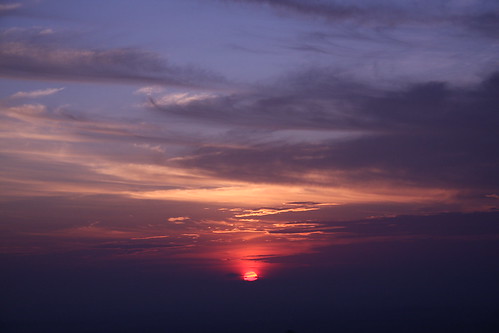
Mysore Sunset

I'm starting my packing up a bit today —what goes in the suitcase bound for Goa/California ... what goes into the trunk to stay. Ah, yes, I'm already making plans to come back amidst the leaving. This is what India does to you...or me anyhow. And practice. It was a very different three months than I expected it might be in terms of my yoga experience. On the outside, perhaps not much has changed. ...but inside things are moving! Suffice to say, I'm ever more astounded at the power of Ashtanga to transform deep, deep patterns. It's not always a quick process, but it's multi-layered and mysterious ...hopefully I'll be able to put this into better words after some reflection on the beaches of Goa next week. In the meantime, I've several more days of Mysore and ...practice!